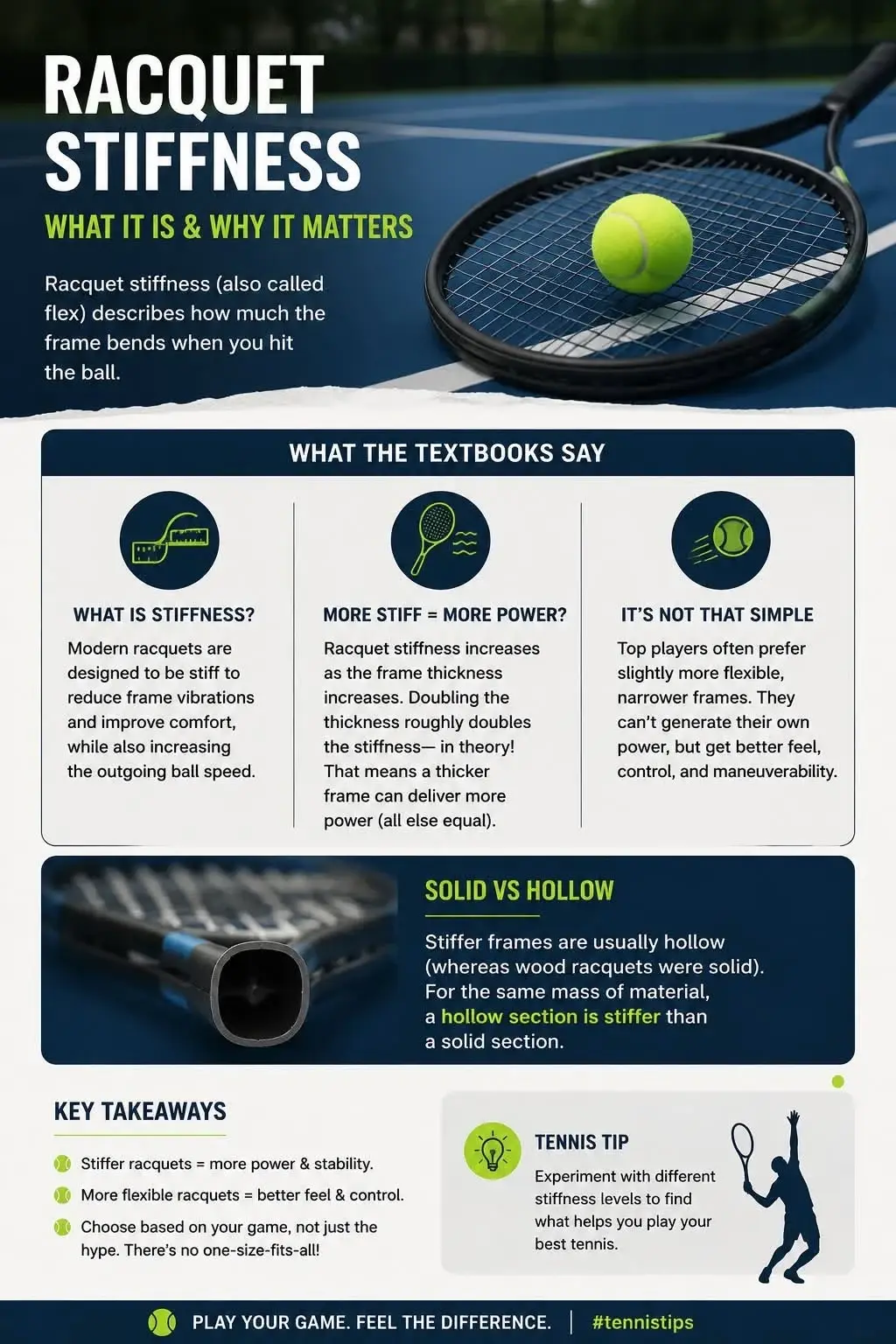
Racket stiffness, also called flex, is how much the frame bends when it hits the ball. You will often see it as an RA number on the spec sheet: the higher the number, the stiffer the frame.
Why most modern rackets are stiff
Modern frames are built stiff on purpose. A stiff frame bends less at impact, so less of the ball's energy is lost bending the racket and more of it goes back into the shot. It also cuts down the frame's vibration.
Stiffness grows quickly with the thickness of the frame. In theory, doubling the thickness of the beam roughly doubles its stiffness, which is why a thicker frame tends to give more power, all else being equal.
Stiffer is not always better
Many strong players choose slightly more flexible, thinner frames. They make their own pace with a fast swing, so they would rather have the feel, control and manoeuvrability a flexible frame gives. A stiffer frame also sends more shock to your arm, which matters if you have a sore elbow or shoulder.
Solid or hollow
Old wooden rackets were solid. Modern frames are hollow, and for the same amount of material, a hollow section is stiffer than a solid one. That is a large part of why today's rackets are so much more powerful.
How to choose
- Stiffer frames give more power and stability.
- More flexible frames give more feel and control, and are kinder to your arm.
- Choose for your own game, not the hype. Try frames of different stiffness and see what helps you play your best.
Your strings change how a frame feels too. A stiff frame with a soft string or a slightly lower tension can feel far more comfortable. Ask Kal and he will help you balance the two.